"Understanding Adversarial AI Attacks: Prevention Strategies Explained"
Table of Contents
- 1.Introduction to Adversarial AI Attacks
- 2.Understanding the Nuances of AI in Cybersecurity
- 3.The Evolution of Cyber Threats: From Traditional to Adversarial
- 4.Mechanisms of Adversarial AI Attacks
- 5.Types of Adversarial AI Attacks: An Overview
- 6.Real-World Examples of High-Profile Adversarial Attacks
- 7.Prevention Strategies: Fortifying AI Systems Against Threats
- 8.Best Practices for Building Resilient AI Environments
Adversarial AI attacks are among the most consequential developments in cybersecurity because they target the very systems we increasingly trust with critical decisions. In simple terms, an adversarial attack feeds an AI model deceptive inputs designed to force a wrong output, whether a misclassification, data leak or hijacked behavior. The manipulation is often imperceptible to humans, which is why these attacks can slip past both human review and traditional, rule-based defenses.
The threat is well documented. NIST AI 100-2 defines a formal taxonomy distinguishing evasion, poisoning and privacy attacks on predictive AI from poisoning and prompt-injection attacks on generative AI, while MITRE ATLAS maps adversary tactics and the OWASP Top 10 for LLM Applications 2025 catalogs the risks for LLM-based apps.
In this guide I will explain the mechanisms behind adversarial AI attacks, walk through the major types with real-world examples, and lay out proven prevention strategies, from adversarial training and input validation to differential privacy and confidential computing, so you can build AI that resists known and emerging attacks.
Introduction to Adversarial AI Attacks
Adversarial AI attacks exploit the fact that machine learning models are not infallible. By feeding a model carefully crafted inputs, an attacker can cause it to misclassify an image, reveal training data or behave in unintended ways, often with changes that are invisible to the human eye. This makes them fundamentally different from traditional vulnerabilities: instead of breaking into a system, the attacker bends the system's perception. NIST's Adversarial Machine Learning report (AI 100-2) is the authoritative reference here, organizing attacks into categories such as evasion, poisoning and privacy attacks for predictive AI, and poisoning, direct prompting and indirect prompt injection for generative AI. Understanding this taxonomy is the first step to defense, because each category requires a different countermeasure, and a model that is robust to one kind of attack can be entirely exposed to another.
Understanding the Nuances of AI in Cybersecurity
AI has transformed cybersecurity by analyzing vast amounts of data faster than any human analyst, but it also introduces unique vulnerabilities. Models depend heavily on their training data, so if that data is biased, incomplete or manipulated, the model's behaviour is compromised, a sensitivity that adversarial techniques are designed to exploit. A model trained on data that fails to represent real-world scenarios becomes an easier target for inputs crafted around those blind spots. The operational context adds further complexity. As AI systems act on their outputs, whether approving a transaction or answering a customer, adversarial manipulation can translate directly into real-world harm. This is why the NIST AI 100-2 taxonomy and MITRE ATLAS emphasize not just the model but the whole pipeline, including the tools and data a model can access. Securing AI therefore demands understanding both the technology and how it is embedded in decision-making, and building diverse, high-quality datasets is a foundational defense.
The Evolution of Cyber Threats: From Traditional to Adversarial
Early cybersecurity threats targeted hardware and software directly, exploiting known vulnerabilities and relying on predictable signatures. Defenses were built around identifying those signatures, a rules-based paradigm that worked when attackers reused the same exploits. The rise of AI has changed the game: adversaries now attack the model itself, using techniques that adapt and evade detection because they do not rely on fixed signatures. Adversarial AI marks a shift from signature matching to anticipating and mitigating behavior that can change and adapt. Because many adversarial examples are transferable, an input crafted against one model can mislead others, creating vulnerabilities that span systems and vendors. This evolution requires security professionals to be not only technically skilled but also proactive, designing defenses that assume an adversary is actively trying to learn and exploit the model's weaknesses, a mindset the frameworks from NIST and MITRE ATLAS are designed to support.
Mechanisms of Adversarial AI Attacks
At the core of adversarial AI is perturbation. Attackers make slight, often imperceptible alterations to legitimate inputs, such as adding noise to an image or tweaking text, so that the model misinterprets the data. Techniques such as the fast gradient sign method (FGSM) and projected gradient descent compute these perturbations by following the model's loss gradient, exploiting the model's own weaknesses against it. Another family of mechanisms targets privacy. Model inversion attacks probe a model's predictions to reconstruct sensitive training data, and membership inference attacks determine whether a specific record was in the training set, as documented in the privacy-attack category of NIST AI 100-2. Transferability amplifies the risk, since an adversarial example crafted for one model often fools others, which is why a layered, defense-in-depth approach is necessary rather than relying on any single model or countermeasure.
Types of Adversarial AI Attacks: An Overview
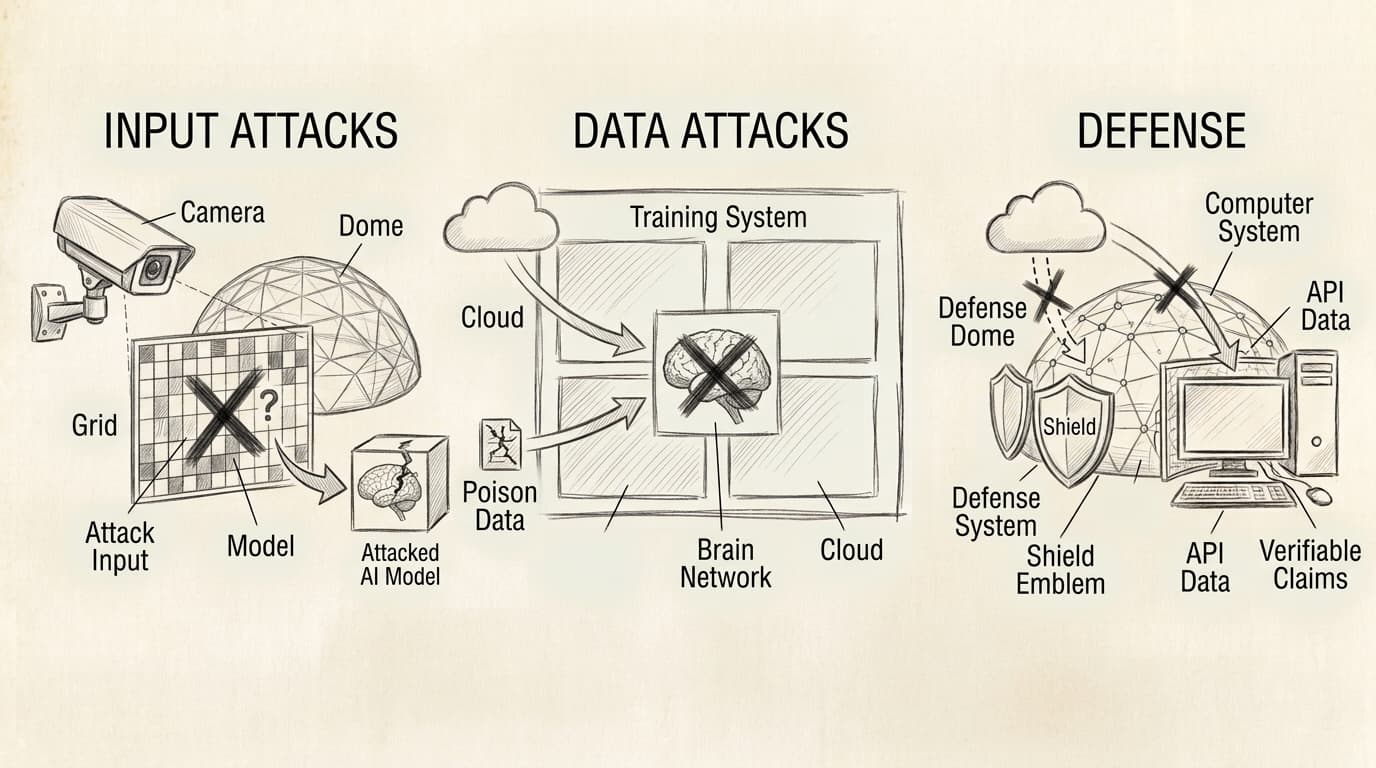
Adversarial AI attacks fall into a few well-defined families. Evasion attacks manipulate inputs at inference time to force misclassification, such as altering an image so a stop sign is read as a yield sign. Poisoning attacks corrupt the model during training or fine-tuning, embedding backdoors or bias that persist in the weights, and OWASP classifies data and model poisoning as critical. Privacy attacks include model extraction, which steals a model's functionality or weights by querying it, and model inversion and membership inference, which reconstruct or confirm sensitive training data. For generative AI, prompt injection, both direct and indirect, and jailbreaks are the dominant risks, overriding the model's instructions through crafted prompts or by hiding instructions in content the model processes. Each type is a distinct failure mode, which is why classification matters: you can only defend against an attack you have correctly identified.
Real-World Examples of High-Profile Adversarial Attacks
The classic illustration remains the autonomous vehicle case, where researchers fooled object-recognition systems by altering a stop sign with stickers, causing the model to misread it as a yield sign, a stark demonstration of the stakes when AI makes life-or-death decisions. Facial recognition systems have likewise been tricked into misidentifying people with subtle image modifications, raising serious concerns for biometric security. The risk is not confined to vision. Recent research showed that model inversion attacks on the Llama 3.2 language model could extract personally identifiable information such as emails, phone numbers and account details that the model had memorized from training data. Indirect prompt injection, where malicious instructions are hidden in documents or web content that a model later processes, has compromised real LLM-integrated applications. These cases, catalogued in NIST AI 100-2 and MITRE ATLAS, show that adversarial AI attacks are not theoretical, they have real consequences that undermine trust in technology.
Prevention Strategies: Fortifying AI Systems Against Threats
Prevention is far more effective than remediation. Adversarial training, exposing the model to adversarial examples during training, measurably hardens it against evasion attacks and is one of the most established defenses. Input sanitization and output filtering block or neutralize malicious inputs and sensitive outputs at inference time, while grounding responses with retrieval (RAG) reduces hallucinations and the impact of prompt injection. Improving model interpretability helps defenders identify weaknesses early, and regular audits, red-team exercises and penetration testing simulate attacks to uncover flaws before adversaries do. For privacy attacks, differential privacy adds calibrated noise during training to limit what the model memorizes about any single record, and data sanitization and deduplication reduce the risk of memorizing sensitive content. Limiting model access through authentication, rate limiting and query monitoring raises the bar for adversaries collecting many samples. Finally, for the most sensitive workloads, confidential computing protects data and model weights during processing, adding a hardware-backed layer that complements these software defenses.
Best Practices for Building Resilient AI Environments
Building a resilient AI environment means integrating security into the development lifecycle from the start. Incorporate adversarial robustness as a design requirement, engage security experts during architecture and training, and adopt frameworks such as NIST AI 100-2 and the OWASP Top 10 for LLM Applications as your checklists. Model diversification through ensemble methods makes it harder for a single attack to mislead all models at once. Operational rigor completes the picture. Maintain data lineage and an ML-BOM to track datasets and dependencies, monitor training loss and model behaviour for signs of poisoning, and run continuous red-team campaigns. Collaboration is essential: by sharing knowledge across the cybersecurity community and working with academic institutions, industry partners and regulators, we can build collective defenses stronger than anything any single organization can achieve on its own.
Conclusion
Adversarial AI attacks are no longer a curiosity; they are a documented, evolving threat that frameworks from NIST (AI 100-2), MITRE ATLAS and OWASP now help us understand and defend against. The key insight is that no single defense is sufficient. Robust models trained adversarially, validated and sanitized inputs, differential privacy, rigorous access control and continuous red-teaming each close a different gap, and for the most sensitive data, confidential computing adds a hardware-backed layer that software alone cannot provide. My years in cybersecurity have convinced me that awareness alone is not enough; the fight requires proactive, layered defense and constant vigilance. By integrating security into every stage of the AI lifecycle and collaborating across the community, we can build systems that are not only powerful but resilient enough to withstand the attacks of today and those still being designed.
Related Content
Latest Posts
External Resources
- - MIT Technology Review on AI and Cybersecurity: https://www.technologyreview.com/2020/10/14/1010622/adversarial-attacks-ai-cybersecurity/
- - NVIDIA AI Security Solutions: https://www.nvidia.com/en-us/deep-learning-ai/security/
- - Stanford University on Adversarial Machine Learning: https://cs.stanford.edu/people/pabbeel/courses/2020_fall/adversarial_machine_learning.pdf
- - OWASP Machine Learning Top 10 Vulnerabilities: https://owasp.org/www-project-machine-learning-top-10/
- - Google AI Safety Research: https://ai.google/research/safety/
- - National Institute of Standards and Technology (NIST) on AI and Cybersecurity: https://www.nist.gov/news-events/news/2022/05/nist-introduces-framework-help-organizations-improve-security-ai-systems
- - Fast Company on How AI is Used in Cybersecurity: https://www.fastcompany.com/90631581/how-ai-is-used-in-cybersecurity
- - Black Hat on AI Security Challenges: https://www.blackhat.com/us-21/briefings/schedule/index.html#ai-security-challenges-23488
- - IEEE Transactions on Information Forensics and Security: https://ieeexplore.ieee.org/xpl/RecentIssue.jsp?punumber=6221036
- - The Conversation on Defending AI Against Attacks: https://theconversation.com/how-to-make-ai-systems-more-resilient-to-adversarial-attacks-129613
Frequently Asked Questions
Q:What are adversarial attacks in the context of AI and cybersecurity?
A:Adversarial attacks attempt to manipulate AI models by introducing subtle, often imperceptible changes to input data, leading to incorrect outputs, data leakage or hijacked behavior, such as misclassifying an image or overriding a model's instructions.
Q:How can AI improve cybersecurity defenses?
A:AI enhances cybersecurity by automating threat detection, analyzing vast amounts of data for patterns and anomalies, and responding to incidents in real time to mitigate damage more quickly than human analysts alone.
Q:What are the common vulnerabilities associated with machine learning, according to NIST and OWASP?
A:NIST AI 100-2 groups them into evasion, poisoning and privacy attacks for predictive AI and poisoning, direct prompting and indirect prompt injection for generative AI, while the OWASP Top 10 for LLM Applications highlights prompt injection, data and model poisoning, supply chain vulnerabilities and sensitive information disclosure.
Q:How does NIST's framework assist organizations in securing AI systems?
A:NIST provides both the AI Risk Management Framework for governing AI risk across its lifecycle and the AI 100-2 report on adversarial machine learning, which establishes a common taxonomy and terminology for identifying, classifying and mitigating attacks on AI systems.
Q:What challenges does AI pose to security according to experts in the field?
A:The main challenges are the complexity and black-box nature of many models, which makes them hard to audit, the expanding surface of adversarial and privacy attacks, and the fact that evolving threats can bypass traditional, signature-based cybersecurity measures.