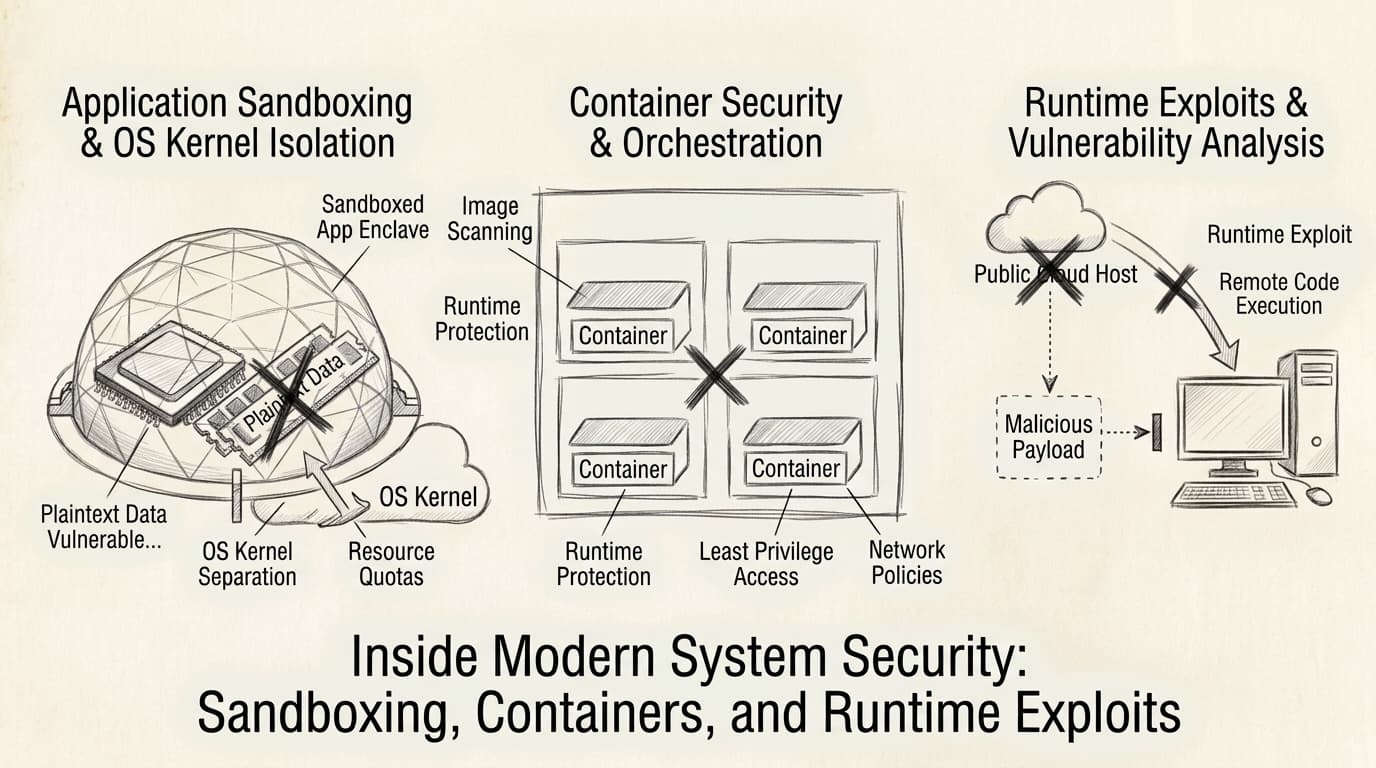
"Inside Modern System Security: Sandboxing, Containers, and Runtime Exploits"
Table of Contents
- 1.Introduction to Cyber Threats and the Need for Innovation
- 2.Understanding Sandboxing: Definition and Importance
- 3.Exploring Containers: What They Are and How They Work
- 4.The Benefits of Sandboxing for Cybersecurity
- 5.Enhancing Security with Containers: Key Advantages
- 6.Real-World Applications: Sandboxing and Containers in Action
- 7.Conclusion: Strengthening Your Cybersecurity Posture with Advanced Technologies
In today’s computing landscape, security is no longer just about preventing attacks—it is about containing damage when things inevitably go wrong. Modern software systems are complex, layered, and built on abstractions that, while powerful, introduce subtle vulnerabilities. As attackers continue to exploit these weaknesses, traditional perimeter-based defenses are proving insufficient. This has shifted the focus of cybersecurity toward isolation, containment, and controlled execution, which form the foundation of modern platform security.
Two of the most important technologies enabling this shift are sandboxing and containers. Rather than attempting to eliminate all bugs—an impossible task—these mechanisms limit how much harm a compromised application can cause. Sandboxing achieves this by restricting what a program can access at runtime, while containers provide lightweight isolation by leveraging kernel features such as namespaces, control groups, and system call filtering. Together, they form a critical defense layer that helps prevent local failures from becoming system-wide compromises.
Understanding these technologies requires looking beneath the surface. Sandboxing relies on operating system primitives such as virtual memory, system call mediation, and access control policies to enforce strict boundaries between applications and system resources. Containers, while often perceived as lightweight virtual machines, actually share the host kernel and depend heavily on correct configuration and kernel-level security mechanisms. This makes them powerful—but also risky if misunderstood.
Throughout this blog, I explore how sandboxing and containers work from a systems perspective, drawing connections between virtual memory, access control, runtime behavior, and isolation mechanisms. By examining how modern operating systems enforce security—and how attackers exploit unintended behavior—we gain a clearer understanding of both the strengths and limitations of these technologies. Ultimately, this discussion highlights why sandboxing and containers are not just deployment tools, but essential components of modern defensive security architecture.
Introduction to Cyber Threats and the Need for Innovation
Modern computing systems operate in an environment where security threats are no longer occasional anomalies but an expected reality. As software complexity increases and systems become more interconnected, the attack surface grows accordingly. Today’s cyber threats extend far beyond simple malware or unauthorized access; they exploit subtle flaws in system design, runtime behavior, and resource management. These threats target not only applications but also the underlying operating system mechanisms that support them. Traditional security approaches, which focus primarily on perimeter defenses and signature-based detection, are no longer sufficient. Attackers increasingly leverage zero-day vulnerabilities, memory corruption bugs, and unintended program behavior to bypass conventional protections. This evolution has forced a fundamental shift in how security is approached—from attempting to prevent all bugs to limiting the impact of inevitable failures. This shift has brought isolation-based security mechanisms to the forefront. Technologies such as sandboxing and containerization represent a move toward containment rather than absolute prevention. Instead of assuming software is trustworthy, modern systems assume compromise is possible and focus on restricting what compromised components can do. This philosophy underpins much of today’s platform security design and is essential for defending complex systems against modern threats.
Understanding Sandboxing: Definition and Importance
Sandboxing is a security mechanism designed to execute code in a tightly controlled environment, isolating it from critical system resources. At its core, sandboxing limits what a process can access—memory, files, system calls, and network interfaces—thereby reducing the potential damage caused by malicious or compromised software. From a systems perspective, sandboxing relies on fundamental operating system primitives such as virtual memory, privilege separation, and system call filtering. By restricting how a process interacts with the kernel and hardware, sandboxes prevent untrusted code from escaping its execution boundary. This is particularly valuable when dealing with unverified inputs, third-party software, or potentially malicious files. Beyond containment, sandboxing plays a crucial role in security analysis. By observing how software behaves inside a controlled environment, security teams can identify exploit attempts, detect abnormal execution patterns, and understand attack techniques without risking production systems. This capability is especially important for analyzing zero-day exploits, where no known signatures exist. Sandboxing therefore serves not only as a defensive tool, but also as an investigative and learning mechanism that strengthens long-term security strategies.
Exploring Containers: What They Are and How They Work
Containers represent a lightweight form of isolation built directly on top of the operating system kernel. Unlike virtual machines, which emulate entire hardware environments, containers share the host kernel while isolating applications using namespaces, control groups, and filesystem overlays. This design enables faster startup times, reduced resource overhead, and greater deployment efficiency. From a security standpoint, containers provide process-level isolation rather than hardware-level isolation. Each container operates within its own namespace, limiting visibility into other processes, network interfaces, and filesystem paths. Resource usage is controlled through cgroups, ensuring that no single container can exhaust system resources. Together, these mechanisms create an environment that is both efficient and constrained. However, because containers share the host kernel, their security depends heavily on correct configuration and kernel integrity. A vulnerability in the kernel or misconfigured permissions can allow container escapes. For this reason, containers are most effective when combined with additional security mechanisms such as seccomp filters, mandatory access control systems, and runtime monitoring. When used correctly, containers offer a powerful balance between flexibility, performance, and security.
The Benefits of Sandboxing for Cybersecurity
One of the most significant advantages of sandboxing is its ability to safely execute and analyze untrusted code. By confining execution to a restricted environment, organizations can observe malicious behavior without exposing core systems to risk. This allows security teams to identify attack vectors, understand exploit techniques, and develop targeted mitigations before real damage occurs. Sandboxing also improves incident response effectiveness. When suspicious activity is detected, security teams can quickly replicate the behavior in an isolated environment, enabling faster diagnosis and remediation. This reduces response time and minimizes uncertainty during active incidents. The ability to test and analyze threats without endangering production systems is a major advantage in modern security operations. Additionally, sandboxing supports continuous improvement of defensive strategies. By studying how malware behaves under controlled conditions, organizations can refine detection rules, update access control policies, and strengthen system configurations. Over time, this feedback loop leads to more resilient systems that are better equipped to handle evolving threats.
Enhancing Security with Containers: Key Advantages
Containers provide significant security benefits when used as part of a well-designed system architecture. One of their primary strengths is workload isolation. By separating applications into discrete units, organizations can limit the impact of a compromise to a single service rather than an entire system. This containment model is especially valuable in microservices architectures, where applications are composed of many independent components. Another major advantage is operational agility. Containers can be created, deployed, and replaced rapidly, allowing organizations to respond quickly to vulnerabilities. When a flaw is discovered, affected containers can be patched or replaced without requiring system-wide downtime. This ability to rapidly adapt is critical in environments where threats evolve continuously. Containers also integrate naturally with modern development pipelines. Security controls can be embedded directly into build and deployment workflows, enabling early detection of vulnerabilities. This “shift-left” approach ensures that security is addressed throughout the software lifecycle rather than treated as an afterthought. When combined with runtime protections, containers form a strong foundation for secure application deployment.
Real-World Applications: Sandboxing and Containers in Action
In practical environments, sandboxing and containers are often used together to create layered defenses. A common example is malware analysis, where suspicious files are executed inside sandboxes to observe their behavior. This allows security teams to identify indicators of compromise and update detection systems without exposing production assets. Containers are widely used in application development and deployment pipelines. By running applications in isolated environments, teams can test new versions, apply security updates, and conduct vulnerability scans without affecting live services. If a flaw is discovered, the affected container can be rebuilt or replaced quickly, minimizing operational disruption. In more advanced deployments, organizations combine both techniques to maximize protection. Containers provide structured isolation for applications, while sandboxing is used to analyze inputs, third-party code, or untrusted data streams. This layered approach reflects modern security principles, where multiple overlapping controls reduce the likelihood of successful exploitation.
Conclusion: Strengthening Your Cybersecurity Posture with Advanced Technologies
As cyber threats continue to evolve in complexity and scale, the need for robust, adaptive security mechanisms has never been greater. Sandboxing and containerization represent essential tools in this effort, offering practical ways to isolate risk, limit damage, and improve system resilience. Rather than relying solely on prevention, these technologies embrace the reality that vulnerabilities will exist and focus on minimizing their impact. However, technology alone is not enough. Effective security also requires informed decision-making, continuous monitoring, and a culture that prioritizes resilience and awareness. When combined with strong operational practices, sandboxing and containers enable organizations to build systems that are not only functional and scalable, but also secure by design. By adopting these technologies and understanding their underlying principles, organizations can better prepare for the challenges of modern cybersecurity. In an environment where threats are inevitable, the ability to contain, analyze, and recover quickly is what ultimately defines a strong security posture
Conclusion
As I reflect on the pressing need for innovation in cybersecurity, it becomes clear that the landscape is not just growing more complex; it’s evolving at an unprecedented pace. My experience has taught me that adopting advanced technologies like sandboxing and containers isn’t just a strategic advantage; it's a necessity for any organization that wants to thrive in today's digital world. These tools not only empower teams to detect and mitigate threats dynamically but also foster a culture of proactive defense. Embracing these innovations, combined with a commitment to continuous learning and awareness, allows organizations to build a resilient cybersecurity posture. Moving forward, we must prioritize not only technological adaptation but also cultivate a security-conscious mindset across all levels of our organizations. This way, we can stay one step ahead of cyber adversaries and safeguard our data in an increasingly interconnected and unpredictable environment.
Related Content
Latest Posts
External Resources
- -What sandboxing is and how it works (CrowdStrike):
- https://www.crowdstrike.com/en-us/cybersecurity-101/threat-intelligence/cybersecurity-sandboxing/
- -General intro to sandboxing in cyber security (Barracuda):
- https://www.barracuda.com/support/glossary/sandboxing
- -Benefits of sandboxing for testing and research (McAfee):
- https://www.mcafee.com/learn/what-is-sandboxing-in-cybersecurity/
- -Fundamental overview of sandboxing, use cases, and why it matters (Rapid7):
- https://www.rapid7.com/fundamentals/sandboxing/
- -Glossary-style definitions of sandbox and containerization from a government cyber guidance site (Canadian Centre for Cyber Security):
- https://www.cyber.gc.ca/en/guidance/top-10-security-actions-no-9-isolate-web-facing-applications-itsm10099
Frequently Asked Questions
Q:Why is innovation crucial in cybersecurity?
A:From my perspective in the field, innovation is essential because cyber threats are constantly evolving, and only through innovative approaches can organizations effectively protect their assets and data.
Q:What are some advanced cybersecurity tools organizations should consider?
A:In my experience, tools such as AI-driven security systems, behavior analytics, and automated incident response platforms can greatly enhance an organization’s cybersecurity posture.
Q:How does sandboxing benefit cybersecurity practices?
A:Based on my understanding, sandboxing allows organizations to isolate potential threats and test malicious code in a safe environment, reducing the risk of harm to actual systems.
Q:What are best practices for ensuring container security?
A:From what I've learned, securing containers involves practices such as implementing runtime security monitoring, regularly scanning images for vulnerabilities, and enforcing strict access controls.
Q:How can organizations build a strong cybersecurity culture?
A:In my observations, fostering a robust cybersecurity culture requires ongoing training, clear communication of policies, and empowering employees to take an active role in identifying and reporting security threats.