What Is Confidential Computing and How Does It Work?
Table of Contents
- 1.What Is Confidential Computing?
- 2.How Does Confidential Computing Protect Data?
- 3.What Problems Does Confidential Computing Solve That Traditional Encryption Cannot?
- 4.What Are Trusted Execution Environments (TEEs)?
- 5.How Does Remote Attestation Work?
- 6.What Are the Key Benefits of Confidential Computing for Enterprises?
- 7.Who Needs Confidential Computing?
- 8.What Are the Key Use Cases of Confidential Computing?
- 9.How Does Confidential Computing Support Zero-Trust Security?
- 10.Can Confidential Computing Prevent Insider Threats?
- 11.How TeyzSec Delivers Trusted Execution for Sensitive Workloads
Confidential computing is the technology that keeps data encrypted even while it is being processed. It closes the gap left by encryption at rest and in transit, protecting the one state of data that has historically been left exposed: data in use.
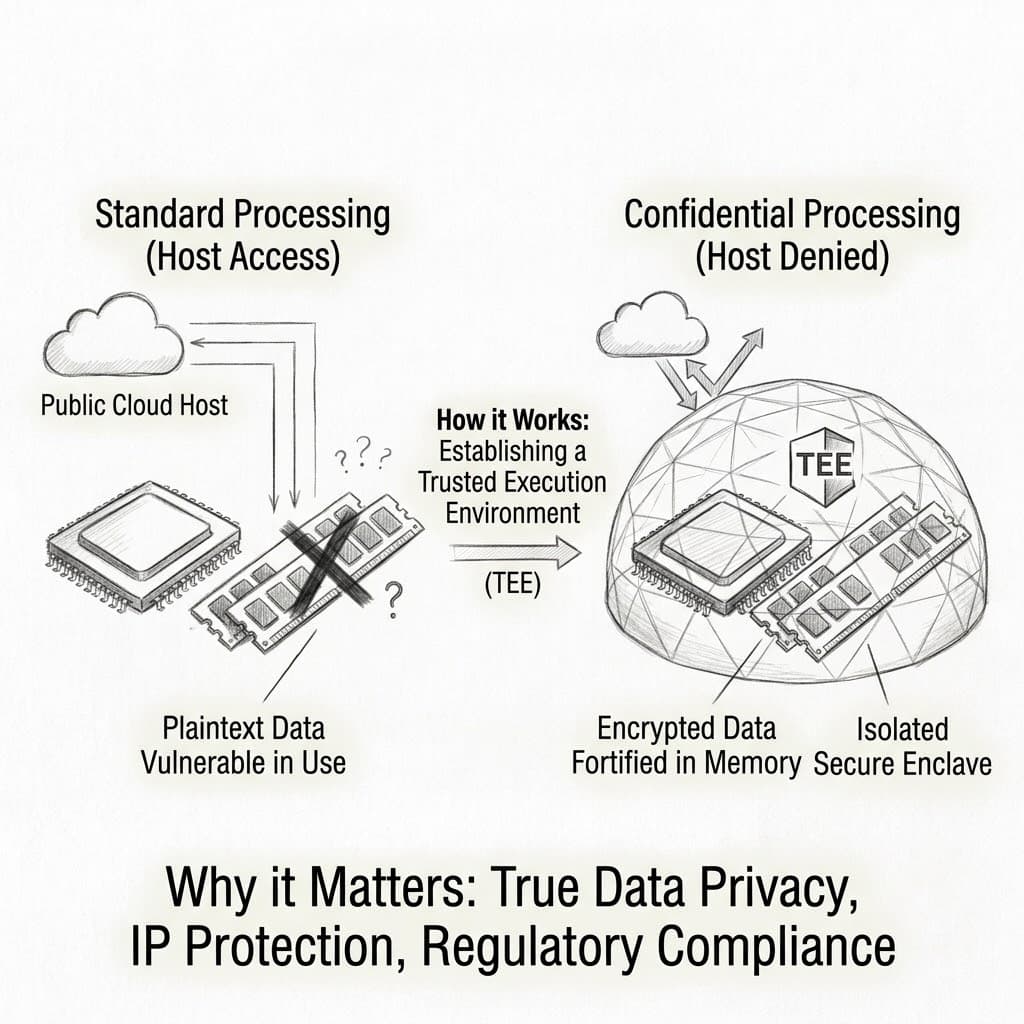
Sensitive information moves through three states. At rest, it sits on disk or in storage. In transit, it travels across networks. In use, it is loaded into memory and actively processed by a CPU. Encryption has long protected the first two states, but once data is decrypted for processing it becomes readable to the operating system, the hypervisor, and anyone with privileged access to the machine. Confidential computing changes that by keeping data encrypted inside a protected region of the processor, even while computation happens on it.
At the foundation of confidential computing are trusted execution environments (TEEs), hardware-backed regions that isolate code and data from the rest of the system. Implementations such as Intel SGX and AMD SEV are widely deployed examples. TeyzSec builds on this foundation by combining hardware-rooted trust with continuous runtime verification, so sensitive workloads stay protected in untrusted environments such as shared clouds and multi-tenant infrastructure.
What Is Confidential Computing?
Confidential computing is a security technology that keeps data encrypted while it is being processed. It extends the protection that encryption provides at rest and in transit to the moment data is actively used, closing the exposure window that opens whenever sensitive data is decrypted for computation. Data exists in three states, and each needs its own protection. At rest, encryption protects data on disks and in databases. In transit, encryption protects data as it moves between systems. In use, data is loaded into memory and processed by a CPU. This third state has historically been the most vulnerable, because decrypting data for processing makes it visible to the operating system, the hypervisor, and anyone with privileged access to the host. Trusted execution environments (TEEs) are the foundation of confidential computing. A TEE is a secure, isolated region inside the processor where code and data can run without being readable by anything outside it. Hardware implementations such as Intel SGX and AMD SEV make this isolation possible at the silicon level. TeyzSec integrates hardware-rooted trust with continuous runtime verification to secure sensitive workloads in untrusted environments. The platform validates the integrity of a machine before sensitive data is released, and keeps verifying it while workloads run, giving enterprises a verifiable trust layer rather than a static security claim.
How Does Confidential Computing Protect Data?
Confidential computing protects data by running workloads inside a trusted execution environment, an isolated and encrypted region within the processor where code and data operate beyond the reach of the operating system, hypervisor, or cloud provider. When a workload enters a TEE, its code and data are encrypted and can only be decrypted inside the enclave. Nothing running outside that region, including privileged system software, can read what is happening inside. The cloud provider that hosts the hardware cannot inspect the computation, and a privileged insider cannot access the data while it is being processed. TeyzSec adds policy-based enforcement on top of this isolation. Workloads are validated against security policies before any sensitive data is decrypted, and encryption keys are only released after the environment passes verification. Even privileged insiders cannot see what is happening inside a secure enclave, because they never hold the keys and never gain access to the plaintext. #
Hardware-Rooted Trust and What It Means for Enterprise Security
Hardware-rooted trust is trust that originates in the processor itself rather than in software that can be modified or bypassed. It binds security claims to physical hardware, creating a foundation that software-only protections cannot match. Software-only controls run on the same hardware they are meant to protect. If an attacker compromises the operating system or firmware, those controls can be disabled or tricked. Hardware-rooted trust anchors verification in tamper-resistant silicon, so the integrity of the environment can be proven even when the surrounding software is untrusted. For sensitive AI and enterprise workloads, this distinction is critical. A breach of a single hypervisor or host could otherwise expose data across many tenants. Hardware-rooted trust removes that single point of failure. It is the core capability behind TeyzSec’s device trust and attestation, which verify that a device is genuine and in an approved state before it is granted access to sensitive data. #
Continuous Runtime Verification: Keeping Workloads Honest
Continuous runtime verification monitors the integrity of a workload throughout its execution, not just at the moment it starts. It detects changes and anomalies while the workload is running, so trust does not silently erode after an initial check passes. A one-time attestation at startup confirms that an environment began in a trusted state. But environments can drift, firmware can be modified, and unauthorized processes can appear. Continuous runtime verification watches for these changes in real time, giving security teams ongoing assurance that the workload is still running as intended. This is a key differentiator for organizations running AI pipelines or regulated workloads in shared or multi-tenant environments. TeyzSec’s continuous runtime verification means a workload is validated once at launch and kept honest for the entire duration of execution, closing the gap between startup checks and steady-state operation.
What Problems Does Confidential Computing Solve That Traditional Encryption Cannot?
Standard encryption protects data at rest and in transit, but it leaves data exposed the moment it is decrypted for processing. Confidential computing solves this problem by keeping data encrypted during computation. When an application needs to process data, traditional encryption requires the data to be decrypted in memory. At that moment, the plaintext is visible to the operating system, the hypervisor, and anyone with privileged access. This window of exposure is a fundamental gap that encryption alone cannot close, because the processor needs access to plaintext to compute on it. Confidential computing eliminates this window by enabling computation on encrypted data inside a TEE. Data stays encrypted while it is processed, so the exposure window simply disappears. For workloads that require even stronger guarantees, TeyzSec supports fully homomorphic encryption (FHE), an additional privacy-enhancing layer that allows computation on encrypted data without ever decrypting it.
What Are Trusted Execution Environments (TEEs)?
A trusted execution environment (TEE) is a secure region inside a processor where sensitive workloads run in isolation. Code and data inside a TEE are protected from everything outside it, including the operating system and the cloud provider. A TEE provides two core guarantees. First, isolation: the code and data running inside the enclave cannot be observed or modified by software running outside it. Second, attestation: the enclave can cryptographically prove its integrity to a remote party before receiving sensitive data. Nothing outside the TEE, including the host operating system or the cloud provider, can read the data inside. This makes TEEs a practical way to run sensitive workloads on infrastructure you do not fully control. TeyzSec builds on TEE technology to deliver deployment-validated capabilities at enterprise scale, applying hardware-based isolation to real production workloads.
How Does Remote Attestation Work?
Remote attestation is a cryptographic process that verifies the integrity of hardware, firmware, and software before a workload is granted access to sensitive data. It turns security from an assumption into a proof. The process works in steps. When a workload requests access to sensitive data, the TEE produces a signed statement describing its hardware configuration, the firmware and software versions it is running, and the measurements that prove its current state. A verifier checks these measurements against expected values. Only if the environment matches the approved state are encryption keys released to the workload. TeyzSec frames attestation as a trust gatekeeper. Keys are not handed out based on identity claims or configuration files; they are released only after the environment passes cryptographic verification. This transforms security from assumption to proof, because the integrity of the environment is demonstrated, not merely declared.
What Are the Key Benefits of Confidential Computing for Enterprises?
Confidential computing delivers four primary benefits: complete data-in-use protection, compliance with regulations such as GDPR and HIPAA, improved cross-organization collaboration, and the enablement of secure AI innovation. The first benefit is complete data-in-use protection. Data is encrypted during processing, not just at rest and in transit, so the most vulnerable state of data is finally protected. The second is regulatory compliance. TEEs help organizations meet requirements under GDPR, HIPAA, PCI DSS, and similar frameworks by protecting sensitive data during processing and enabling audit trails. The third is collaboration: confidential computing creates a neutral, verifiable environment where multiple organizations can work together without exposing their underlying data. The fourth is secure AI innovation, allowing organizations to run AI on sensitive data without sacrificing privacy. Each benefit maps to TeyzSec platform features. Selective encrypted analytics and federated learning support let enterprises gain insights from sensitive data while keeping the raw data protected, making compliance and collaboration practical rather than theoretical. #
Confidential Computing and Regulatory Compliance
TEEs help organizations meet requirements under GDPR, HIPAA, PCI DSS, and similar frameworks by protecting sensitive data during processing and enabling audit trails. Many regulations require organizations to protect personal and sensitive data throughout its lifecycle. Encrypting data at rest and in transit covers two states, but regulators increasingly scrutinize how data is handled during processing. Confidential computing closes that gap, ensuring data remains protected even while it is actively used. Attestation also supports auditability. Because the environment’s integrity is cryptographically verified, organizations can produce evidence that sensitive workloads ran in a trusted state. TeyzSec’s policy-based enforcement supports data residency and sovereignty requirements for regulated and telecommunications sectors, giving those industries the controls they need to operate across jurisdictions. #
Secure Data Collaboration Without Exposing Sensitive Information
Confidential computing creates a neutral, verifiable environment where multiple parties can collaborate on shared data or AI models without revealing their underlying assets. In a TEE, each participant’s data is processed in isolation, and the environment proves to all parties that the computation is running correctly without exposing their inputs to one another. This makes it possible to derive joint value from shared data while keeping each party’s sensitive information private. Practical examples span several industries. In financial services, institutions can run fraud detection across their combined transaction data without exposing customer records. In healthcare, research organizations can train models on pooled clinical data while protecting patient privacy. In telecommunications, carriers can share threat intelligence for network security without revealing proprietary network details.
Who Needs Confidential Computing?
The enterprise segments with the greatest need are telecommunications, financial services, healthcare, government, and any organization running AI on sensitive data. These industries handle data that is highly regulated, commercially sensitive, or both. Telecommunications carriers protect subscriber data and network intelligence. Financial institutions protect transaction data and customer records. Healthcare organizations protect patient information. Governments protect citizen data and national-security assets. In every case, the cost of a data exposure is severe, and the infrastructure that processes the data is increasingly shared or cloud-hosted. With growing AI adoption, the need to protect training data, model weights, and inference outputs has become critical. AI models trained on sensitive data, and the data they process, are prime targets. TeyzSec is purpose-built for these environments, offering trusted AI processing in untrusted environments so organizations can adopt AI without abandoning security.
What Are the Key Use Cases of Confidential Computing?
The most impactful use cases are securing AI model training and inference, protecting healthcare data pipelines, enabling cross-organization fraud detection, securing federated learning workflows, and protecting blockchain and digital asset platforms. Each use case shares the same core requirement: process sensitive data in an environment where it cannot be exposed. Confidential computing provides that environment, and TeyzSec connects each requirement to a concrete capability. For AI, TEEs keep training data and model weights protected during computation, while federated learning and fully homomorphic encryption further reduce data-sharing risk. For healthcare, confidential computing protects patient data as it moves through analytical pipelines. For financial services, it enables cross-organization fraud detection without sharing raw records. For blockchain and digital assets, it protects private keys and transaction logic from the infrastructure that hosts them. #
Securing AI Workloads with Confidential Computing
Both training data and model weights are exposed during standard AI processing. Running them inside a TEE eliminates that exposure. During training and inference, a model loads weights and data into memory and computes on them in plaintext. In a conventional environment, that plaintext is visible to the host operating system and the cloud provider. Confidential computing keeps those operations inside an isolated enclave, so the model and its data remain protected even while they are actively used. TeyzSec supports federated learning and fully homomorphic encryption as mechanisms that further reduce data-sharing risk in distributed AI environments. Federated learning keeps raw data on local nodes and shares only model updates. FHE allows computation on encrypted data without decrypting it. Together they give organizations options for protecting AI workloads based on their specific risk profile. #
Confidential Computing in GPU Environments
Confidential computing extends protection beyond CPUs into GPU-accelerated AI workloads through hardware-isolated environments. Modern AI workloads depend on GPUs for performance, and those GPUs are increasingly shared across tenants in cloud environments. Without protection, a model’s weights, prompts, and training data are exposed in GPU memory during processing. Confidential computing addresses this by isolating GPU workloads in hardware-protected environments. TeyzSec ensures that sensitive assets such as model weights, prompts, and training data remain encrypted even in shared GPU clouds. This makes confidential computing viable for the high-performance AI workloads that enterprises increasingly rely on, without forcing them to trade security for speed.
How Does Confidential Computing Support Zero-Trust Security?
Confidential computing implements the zero-trust principle of never trusting and always verifying at the compute layer. Zero-trust architectures assume that no network, host, or user can be inherently trusted. Every access request must be verified. Confidential computing applies this same logic to the processor itself: no workload is trusted to touch sensitive data until its environment has cryptographically proven its integrity. TeyzSec’s attestation and policy-based enforcement ensure that no workload accesses sensitive data without cryptographic proof of its integrity. Access is granted only after verification, and it is continuously re-evaluated while the workload runs. This moves an organization’s security posture from trust assumption to trust verification, closing the loop that traditional perimeter defenses leave open.
Can Confidential Computing Prevent Insider Threats?
Confidential computing neutralizes insider threat vectors by ensuring that even privileged administrators cannot access data inside a secure enclave. Privileged access is the weakest link in traditional security. Cloud administrators, database admins, and operators with high-level access can typically view data in memory or in logs. Inside a TEE, none of this is possible. The data is encrypted and can only be decrypted within the enclave, which even the host operator cannot enter. Access to encryption keys is tightly controlled so that no user, regardless of privilege level, can bypass the protections without triggering an attestation failure. If a workload attempts to run in an unverified environment, the keys are withheld. TeyzSec’s continuous runtime verification adds a further layer, detecting anomalous behavior during execution so that insider threats are identified even if they attempt to act during a session.
How TeyzSec Delivers Trusted Execution for Sensitive Workloads
TeyzSec delivers an end-to-end approach to trusted execution, combining hardware-rooted trust, attestation-gated key release, policy-based enforcement, and runtime verification into a single cohesive security layer. The chain works together. Hardware-rooted trust establishes a foundation that originates in silicon. Attestation gates the release of encryption keys, so no sensitive data is exposed until the environment proves its integrity. Policy-based enforcement validates workloads against defined security requirements before they are allowed to touch data. Continuous runtime verification keeps that trust intact for the duration of execution. Deployment-validated capabilities are the mechanism that ensures workloads meet security requirements before they access data. Rather than promising security in theory, TeyzSec verifies it against real deployments and real hardware. Looking forward, TeyzSec is committed to bringing trusted execution to enterprise AI and regulated industries, making confidential computing a practical, verifiable standard for the workloads that matter most.
Conclusion
Confidential computing closes the last unprotected state of data. By keeping information encrypted while it is processed, it protects sensitive workloads in the one environment where traditional encryption cannot help: the moment of computation.
For enterprises running AI, handling regulated data, or collaborating across organizations, this matters more than ever. Trusted execution environments, remote attestation, and continuous runtime verification turn security from an assumption into a proof. TeyzSec combines these capabilities into a single platform that is hardware-rooted, policy-driven, and deployment-validated, purpose-built for enterprises that must secure sensitive workloads in untrusted environments.
Related Content
Latest Posts
External Resources
- [Intel SGX Documentation]: https://www.intel.com/content/www/us/en/developer/tools/software-guard-extensions/overview.html
- [AMD SEV (Secure Encrypted Virtualization)]: https://www.amd.com/en/developer/sev.html
- [Fully Homomorphic Encryption (FHE) Overview]: https://en.wikipedia.org/wiki/Homomorphic_encryption
- [GDPR Official Website]: https://gdpr-info.eu/
- [HIPAA Privacy Rule]: https://www.hhs.gov/hipaa/for-professionals/privacy/index.html
Frequently Asked Questions
Q:What is confidential computing and why does it matter for enterprise security?
A:Confidential computing keeps data encrypted while it is being processed, closing the gap left by encryption at rest and in transit. It matters because data in use is the most vulnerable state, and confidential computing protects it with hardware-based isolation.
Q:How is confidential computing different from standard encryption at rest and in transit?
A:Standard encryption protects data when it is stored or transmitted, but it must be decrypted for processing. Confidential computing keeps data encrypted during computation, eliminating the exposure window that opens when data is decrypted.
Q:What is a trusted execution environment and how does it protect sensitive data?
A:A trusted execution environment (TEE) is a secure, isolated region inside a processor where code and data run beyond the reach of the operating system, hypervisor, and cloud provider. It protects data by keeping it encrypted and inaccessible to anything outside the enclave.
Q:How does remote attestation prove that a workload is running in a secure environment?
A:Remote attestation uses cryptographic measurements to verify the integrity of hardware, firmware, and software before a workload receives sensitive data. Encryption keys are released only after the environment passes verification.
Q:Can confidential computing protect AI model weights and training data during processing?
A:Yes. Running AI workloads inside a TEE keeps model weights, prompts, and training data encrypted during training and inference, so they cannot be read by the host operating system or cloud provider.
Q:How does confidential computing support zero-trust security architectures?
A:Confidential computing applies the zero-trust principle of never trusting and always verifying at the compute layer. No workload accesses sensitive data without cryptographic proof of its environment’s integrity.
Q:Which industries benefit most from confidential computing solutions?
A:Telecommunications, financial services, healthcare, government, and any organization running AI on sensitive data benefit most. These sectors handle regulated or commercially sensitive data processed on shared infrastructure.
Q:Can confidential computing prevent insider threats from privileged cloud administrators?
A:Yes. Even privileged administrators cannot access data inside a secure enclave. Encryption keys are controlled so that no user can bypass protections without triggering an attestation failure.
Q:How does federated learning work with confidential computing to protect distributed AI workloads?
A:Federated learning keeps raw data on local nodes and shares only model updates. Combined with confidential computing, the updates are processed in secure enclaves, protecting both local data and the aggregated model.
Q:What is fully homomorphic encryption and how does it complement confidential computing?
A:FHE enables computation on encrypted data without ever decrypting it. It complements confidential computing by providing an additional privacy-enhancing layer for workloads that require the strongest possible protection.
Q:How does confidential computing help organizations meet GDPR and HIPAA requirements?
A:TEEs protect sensitive data during processing and enable audit trails, helping organizations demonstrate that data is protected throughout its lifecycle, which supports compliance with GDPR, HIPAA, and PCI DSS.
Q:Can confidential computing ensure data sovereignty when workloads run in public clouds?
A:Yes. TeyzSec’s policy-based enforcement supports data residency and sovereignty requirements, allowing regulated organizations to control where and how data is processed even in public clouds.
Q:How does hardware-rooted trust differ from software-based security controls?
A:Hardware-rooted trust originates in tamper-resistant silicon and cannot be modified or bypassed by compromised software. Software-only controls run on the same hardware they protect and can be disabled by an attacker.
Q:What role does policy-based enforcement play in confidential computing platforms?
A:Policy-based enforcement validates workloads against defined security requirements before any sensitive data is decrypted, ensuring that only verified environments receive access to protected data.
Q:How does confidential computing enable secure collaboration between organizations without exposing sensitive data?
A:It creates a neutral, verifiable environment where multiple parties can collaborate on shared data or AI models. Each party’s data is processed in isolation, and attestation proves the computation is correct without exposing inputs.